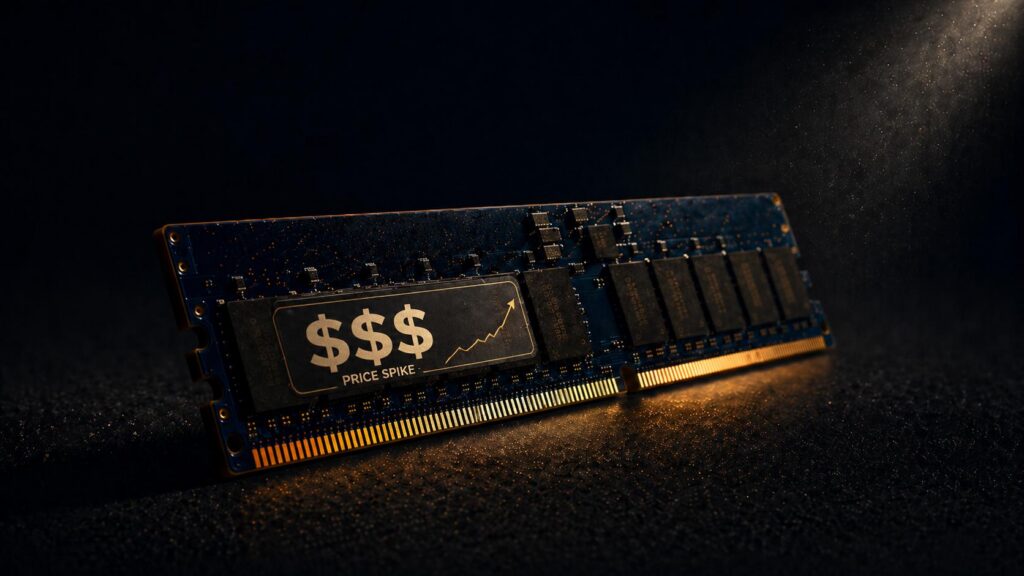
If you’re building a 2026 IT hardware budget, the numbers you used last year are wrong. Memory contract prices climbed 90–95% in Q1 2026. Dell raised list prices 17% on March 30 and has bumped them multiple times since. Microsoft has another price increase landing in June. The analysts at TrendForce, Gartner, IDC, and Counterpoint Research now agree on the same forecast: no meaningful relief through Q1 2027. This post pulls together what they’re saying, what we’re seeing in real OEM quotes right now, and the procurement moves that actually work in this market.
This is for IT directors and decision-makers running 2026 and 2027 hardware planning. We’ll cover where prices stand, what five major analysts forecast through Q1 2027, what’s happening at Dell, HP, Lenovo, Asus, and Microsoft right now, and how to protect your budget without overpaying.
If you’ve been holding out for relief, the next four quarters are going to settle the question.
How We Got Here: Q1 2026 Set the Tone
Q1 2026 broke records. TrendForce’s reported DRAM jump was the largest single-quarter increase ever recorded. Server DRAM rose more than 60%. PC DRAM rose over 100%. Enterprise SSDs jumped 53–58%. None of those numbers are typos.
The cause is structural. AI infrastructure demand from hyperscalers absorbed an unprecedented share of memory production. Samsung, SK Hynix, and Micron deliberately constrained supply growth to protect pricing power. The 2020-2022 oversupply downturn taught them what happens when they flood the market. They’re not making that mistake again.
Now the forward question: what’s coming next?
What’s Coming for IT Hardware Budgets Through Q1 2027
TrendForce: Q2 Hits Harder, From a Different Angle
TrendForce projects another 58–63% QoQ rise in DRAM contract prices for Q2 2026, on top of the Q1 jump. NAND Flash is even more aggressive: Q2 contract prices are forecast to climb 70–75% QoQ, the largest jump on record for that category. Enterprise SSD demand is now the largest NAND segment globally, and CSPs are signing long-term agreements that effectively guarantee supply at premium prices, leaving everyone else fighting for what’s left. For Q3 and Q4, TrendForce’s outlook is “tight supply persists despite advanced process transitions.” Translation: don’t expect a peak. Expect a plateau at elevated levels.
Gartner: Memory Now Eats 23% of PC Build Cost
Gartner’s February 2026 forecast projects total combined DRAM and SSD price increases of roughly 130% by year-end 2026. The downstream effect: memory will account for 23% of a PC’s total bill of materials by Q4 2026, up from 16% in 2025. HP confirmed this on their earnings call, where memory and storage went from 15–18% of PC BOM to 35% in a single quarter. For enterprise IT specifically, Gartner is calling for an 8–12% budget increase just to maintain unit volume into 2027. Anyone planning a 2027 refresh on a 2025 budget framework is going to come up short.
IDC: Budget for Another 10–15% as Q3 Pricing Lands
IDC’s procurement guidance is direct. Any device order placed after April 2026 should assume the higher of currently quoted prices, with explicit budget contingency for an additional 10–15% increase as Q3 contract pricing flows through customer pipelines. For PC market dynamics, IDC’s pessimistic scenario forecasts an 11.3% contraction in shipments through 2026, with no rebound until 2028. That contraction is happening because end-buyers are extending lifecycles, not because business demand softened.
Counterpoint: DDR5 Server Memory Will Double
Counterpoint’s analysis is the most pointed for enterprise IT. DDR5 64GB RDIMM modules, the workhorse of enterprise data centers, are projected to cost twice as much by year-end 2026 versus early 2025. Their Q3-Q4 outlook calls for continued tightness with only modest easing potential. Their advice for non-hyperscaler buyers heading into 2027: stagger procurement across quarters to average out cost spikes, and lock in supply agreements wherever possible.
The Manufacturers: Booked Through 2027
This is the data point that should reset your assumptions. SK Hynix told investors at recent IR sessions that DRAM prices are expected to continue rising “for several years” and is responding by relying on short-term contracts rather than locking in volume agreements. Samsung is currently fulfilling only 70% of incoming DRAM orders. Both companies have signaled they will not aggressively expand capacity, prioritizing long-term margin over volume. Micron exited the consumer memory market entirely to focus on enterprise and AI customers, with their CEO confirming “demand significantly in excess of our available supply for the foreseeable future.”
The capital plans tell the same story. SK Hynix’s M15X mega-fab and Samsung’s P4L expansion don’t reach volume production until late 2027. New Micron capacity in Idaho ramps in 2027, with their Japan plant not online until late 2028. Industry analysts now openly state there is “no scenario where memory prices correct in the second half of 2027.”
From the Trenches: What Vendors Are Actually Doing Right Now
The analyst data is one half of the story. The other half is what’s actually showing up in OEM quotes and partner pricing this week. Here’s what we’re seeing across our active vendor relationships:
Dell. The 17% list price increase landed March 30, 2026, and Dell has raised pricing multiple times in the weeks since. Quote validity is down to 7–14 days on most server configs. Allocation is tight on RDIMM-heavy builds.
HP and Lenovo. Both have signaled 15–20% increases on PC product lines. Lenovo is also pulling some entry-level configurations entirely because the BOM math no longer works.
Asus. This is the surprise of Q2. Asus laptop pricing is currently the most attractive in our portfolio, partly because they’re not as deep in hyperscaler-allocation queues as the bigger names. For 50–500 person companies refreshing endpoint fleets in 2026, Asus is worth a serious look. We’re spec’ing them more often than we did six months ago.
Cisco. Compute price increases hit March 7, 2026, with continued pressure on memory-heavy product lines.
Microsoft. Another price increase is scheduled for June 2026, and the cumulative effect since the New Commerce Experience changes is real money on a 200-user M365 tenant. EA volume discounts on Azure have already been removed, creating a 6–12% uplift on cloud services. If you’re approaching an EA renewal, the math has changed.
If you’re working with a single-OEM partner, this is the part of the cycle where that limitation costs you the most. Multi-OEM access means we can quote across Dell, HPE, Lenovo, and Asus in parallel and find inventory and pricing that single-vendor partners can’t.
The Forward-Looking Picture, in One Frame
|
Quarter |
What to expect |
|---|---|
|
Q2 2026 (now) |
DRAM contract prices +58–63% QoQ. NAND +70–75% QoQ. Quote validity windows under 14 days. |
|
Q3 2026 |
Plateau at elevated levels likely. Continued allocation pressure. New HBM4 production absorbs more wafer capacity. |
|
Q4 2026 |
DRAM/SSD prices peak at +130% combined vs. 2025. Memory hits 23% of PC BOM. Enterprise budgets need 8–12% bump. |
|
Q1 2027 |
Tight supply continues. New fab capacity (Samsung P4L, SK Hynix M15X) still not at volume. No meaningful relief. |
The entire 2026 budget cycle and most of the 2027 budget cycle will be planned and executed inside this market. The “wait it out” option is gone.
The “Wait Tax”: What Delay Actually Costs
Procurement analysts are calling the cost of delay the “Wait Tax.” It’s running roughly 5–10% per month in lost purchasing power, depending on category. OEM quote validity has collapsed in parallel: standard 30-day quote windows are now 14 days at most, often 7 days or less on tightly allocated server memory configurations.
Waiting isn’t a neutral choice. It’s an actively expensive one with no payoff. A quote you decline this Monday could be 8–10% more expensive 30 days from now, assuming the OEM honors a re-quote at all. If they don’t, you’re back at the end of the allocation queue.
One IT director on r/sysadmin documented a scenario where a CFO delayed approval on a routine server purchase. The OEM unilaterally canceled the purchase order and forced a re-quote, raising the per-unit cost from $15,000 to $40,000 in the time it took to circle back. That’s a 167% increase in weeks of indecision.
The framing for finance: delaying a Q3 2026 refresh into Q1 2027 doesn’t save money. It costs you 30–50% more for the same equipment, with longer lead times and more allocation risk.

What This Means for Your 2026 Hardware Refresh Plan
Server and Infrastructure Refreshes
A standard 256GB virtualization host quoted today versus 12 months from now will likely show a 30–50% gap. Lead times have stretched: enterprise storage arrays up to 52 weeks, network switches up to 18 months, even standard servers running 4–8 weeks. If your 2027 plan involves a storage refresh, lock in pricing and inventory now. For organizations doing a full infrastructure refresh, this is also the right time to revisit virtualization, hyper-converged, and DR architecture together rather than refreshing piece by piece. We cover that scope under infrastructure refresh and modernization planning.
Endpoint Refresh Cycles
Gartner expects PC lifetime to extend 15% for business users and 20% for consumers by year-end 2026. That’s a market reaction, not a recommendation. Be careful how far you stretch: extending past warranty and end-of-life support windows opens cyber insurance coverage gaps and compliance issues.
Storage Strategy
Enterprise SSDs are now the largest NAND segment globally, and capacity allocation is going to data centers first. High-capacity QLC enterprise drives are getting harder to source at any price. If your 2027 plan involves a storage refresh, lock in pricing and inventory now.
Cloud vs. On-Prem Economics
This is the surprise. Public cloud is no longer a refuge from hardware inflation. AWS implemented a 15% price hike on EC2 ML compute blocks in January 2026. Azure removed Enterprise Agreement volume discounts, creating a 6–12% uplift across cloud services. The historical “if hardware gets expensive, move to cloud” calculation no longer cleanly works. Hybrid and repatriation strategies are gaining traction precisely because cloud pricing volatility is now its own risk.
Six Procurement Moves That Protect Your Budget
You can’t change the market. You can change how you buy in it.
- Lock in quotes and inventory now for 2027 plans. If your refresh is anywhere between Q4 2026 and Q3 2027, accelerate the procurement timeline. Locking in current pricing protects you from the next contract increase. Some partners will warehouse the inventory until your deployment window opens, which keeps the warranty clock from starting prematurely. This is buy-and-hold, and it’s the most defensible procurement move in this market.
- Right-size memory configs honestly. Spec’ing a server with 256GB because “headroom is nice” is a luxury that costs real money in 2026 and will cost more in 2027. Validate actual memory utilization before adding capacity that won’t get used. The cost of over-provisioning has tripled in 12 months.
- Stagger rollouts to average out cost spikes. Counterpoint’s guidance for non-hyperscaler buyers is sound: stagger purchases across quarters rather than buying everything at once. If you have a 50-device refresh, don’t sign one PO for all 50 in Q3. Split it across Q3, Q4, Q1, Q2 and average the cost curve.
- Consider certified refurbished for non-critical infrastructure. Refurbished enterprise hardware is priced based on pre-crisis acquisition costs, structurally insulated from current spot market spikes. Savings of 50–80% versus net-new are common, with immediate fulfillment instead of 8-week lead times. For backup virtualization hosts, dev environments, or non-production workloads, this is strategic procurement, not a downgrade.
- Use multi-vendor leverage. If your vendor relationship locks you into one OEM, you’re stuck with their pricing and allocation. Access to Dell, HPE, Lenovo, Asus, and Apple in parallel means options. In a market where OEMs are prioritizing hyperscalers, having parallel relationships is the difference between getting your order filled in Q3 versus getting bumped to Q1.
- Push lifecycle management harder. Extending the productive life of existing hardware through better maintenance, monitoring, and zero-touch deployment is suddenly worth more than it was 18 months ago. This is also where co-managed IT support earns its keep, extending lifecycle without burning out your internal team. Just be careful: extending past warranty exposes you to compliance and cyber insurance issues. Track those edges carefully.
How 5 Point Helps in This Market
We sell hardware differently because we’re vendor-agnostic by design. In a market where allocation determines who gets equipment and at what price, that approach matters. We work across Dell (Gold Partner), HPE, Lenovo, Asus, and Apple in parallel, which means we find inventory and pricing that single-vendor partners can’t. Our zero-touch deployment, warehousing, and lifecycle management handles imaging, configuration, Auto Pilot enrollment, and storage end-to-end, so you can lock in 2026 pricing today and deploy on your own timeline. We size configs honestly: every gig of RAM is real money in this market, and over-spec’ing to pad invoices isn’t how we work.
This is for IT directors and decision-makers running 2026 and 2027 hardware planning. We’ll cover where prices stand, what five major analysts forecast through Q1 2027, what’s happening at Dell, HP, Lenovo, Asus, and Microsoft right now, and how to protect your budget without overpaying.
If you’ve been holding out for relief, the next four quarters are going to settle the question.
BOTTOM LINE
Memory and compute pricing isn’t peaking and rolling over. The data through Q1 2027 says the market is plateauing at elevated levels with no meaningful relief until late 2027 at the earliest. Anyone planning their 2026 or 2027 hardware spend on the assumption that “prices will come down” is planning incorrectly. The companies that come out of this in good shape will be the ones who plan honestly, lock in pricing strategically, manage allocation relationships, and squeeze more value out of every dollar of hardware spend.
If you’re working through 2026-2027 hardware planning and want a second set of eyes on your refresh strategy, vendor pricing, or lifecycle approach, that’s a 30-minute conversation worth having. We can usually surface meaningful savings or risk areas in that window. Worst case, you’ve got a second opinion.
FAQ: 2026 IT Hardware Budget Planning
Why are IT hardware prices rising in 2026?
AI infrastructure demand is the cause. Hyperscalers are absorbing the majority of memory production, and Samsung, SK Hynix, and Micron have shifted wafer capacity toward high-bandwidth memory (HBM) for AI accelerators. That leaves less DRAM and NAND for enterprise servers, laptops, and workstations. The shift is structural, not cyclical, and IDC has called it a permanent reallocation of supplier capacity.
How much should I increase my 2026 IT hardware budget?
Gartner is calling for an 8 to 12 percent budget increase just to maintain unit volume into 2027. For a major server refresh, plan for 30 to 50 percent more than 2025 quotes. Endpoint refreshes are running 15 to 30 percent higher across Dell, HP, and Lenovo. Asus is one of the few brands holding closer to last year’s pricing.
Should I delay my 2026 hardware refresh to wait for prices to drop?
No. Industry analysts agree that prices will not meaningfully correct before late 2027, and possibly not until 2028. Procurement teams call the cost of delay the “Wait Tax,” currently 5 to 10 percent per month. Quote validity windows have collapsed from 30 days to 7 to 14 days. Waiting actively costs more with no payoff.
When will memory prices come back down?
Not in 2026, and probably not in 2027. SK Hynix’s M15X and Samsung’s P4L mega-fabs do not reach volume production until late 2027. Micron’s Idaho expansion ramps in 2027. Industry analysts now forecast no scenario where memory prices correct in the second half of 2027.
How much have Dell, HP, and Lenovo raised prices in 2026?
Dell implemented a roughly 17 percent list price increase effective March 30, 2026, and has raised prices multiple times since. Cisco implemented compute price increases on March 7. Lenovo, HP, Acer, and Asus have all warned of 15 to 20 percent PC price increases. Microsoft has additional price changes scheduled for June 2026.
What's the best procurement strategy for the 2026 memory shortage?
Lock in current pricing for 2027 refresh plans. Stagger purchases across quarters rather than buying in one shot. Right-size memory configs instead of speccing for headroom. Use multi-vendor leverage across Dell, HPE, Lenovo, and Asus. Consider certified refurbished for non-critical infrastructure.
Are cloud services a cheaper alternative to buying hardware in 2026?
Not anymore. AWS implemented a 15 percent price hike on EC2 ML compute blocks in January 2026. Azure removed Enterprise Agreement volume discounts, creating a 6 to 12 percent uplift. The historical “move to cloud” calculation no longer cleanly works. Hybrid and on-prem repatriation are gaining traction.
Sources Referenced
TrendForce, Memory Price Outlooks for 1Q26 and 2Q26
Gartner, Worldwide IT Spending Forecast 2026 and Surging Memory Costs Forecast
IDC, Global Memory Shortage Crisis: Market Analysis
Counterpoint Research, Memory Market Analysis Q1 2026
The Wall Street Journal, RAM Shortage Reporting (January 2026)
Tom’s Hardware, Data Centers and 70% Memory Consumption